Showing posts with label Kentucky Governor. Show all posts

Tuesday, May 19, 2020

The fault is ours


Click on the image to make it larger. Jordan Palmer with Kentucky Equality Federation comments on COVID-19 deaths due to Trump's inaction.

Thursday, November 30, 2017

1 in 4 LGBTI people report discrimination in 2016 - SPECIAL REPORT

A disturbing report was issued by the Center for American Progress about LGBTI discrimination. 1 in 4 LGBT people report experiencing discrimination in 2016.

"This is clearly unacceptable and we must eliminate the Kentucky Religious Freedom Act. We call on the Kentucky Supreme Court to overturn this legislation which is effectively a license to discriminate," stated Jordan Palmer, secretary-general of Kentucky Equality Federation, Marriage Equality Kentucky, Southeastern Kentucky Stop Hate Group, Be Proud - Western Kentucky, Kentucky HIV Advocacy Campaign, Kentucky Equal Ballot Access, and others combined together in the Earth Equality Alliance.

Over the past decade, the nation has made unprecedented progress toward LGBTI equality. But to date, neither the federal government nor most states (including the Commonwealth of Kentucky - http://kentucky.gov) have explicit statutory nondiscrimination laws protecting people on the basis of sexual orientation and gender identity. LGBTI people still face widespread discrimination: Between 11 percent and 28 percent of LGBTI workers report losing a promotion simply because of their sexual orientation, and 27 percent of transgender workers report being fired, not hired, or denied a promotion in the past year. Discrimination also routinely affects LGBTI people beyond the workplace, sometimes costing them their homes, access to education, and even the ability to engage in public life.

Data from a nationally representative survey of LGBTI people conducted by CAP shows that 25.2 percent of LGBTI respondents has experienced discrimination because of their sexual orientation or gender identity in the past year. The January 2017 survey shows that, despite progress, in 2016 discrimination remained a widespread threat to LGBTI people’s well-being, health, and economic security.

Among people who experienced sexual orientation- or gender-identity-based discrimination in the past year:
  • 68.5 percent reported that discrimination at least somewhat negatively affected their psychological well-being. 
  • 43.7 percent reported that discrimination negatively impacted their physical well-being. 
  • 47.7 percent reported that discrimination negatively impacted their spiritual well-being. 
  • 38.5 percent reported discrimination negatively impacted their school environment. 
  • 52.8 percent reported that discrimination negatively impacted their work environment. 
  • 56.6 report it negatively impacted their neighborhood and community environment. 

Unseen harms
LGBTI people who don’t experience overt discrimination, such as being fired from a job, may still find that the threat of it shapes their lives in subtle but profound ways. David M., a gay man, works at a Fortune 500 company with a formal, written nondiscrimination policy. “I couldn’t be fired for being gay,” he said. But David went on to explain, “When partners at the firm invite straight men to squash or drinks, they don’t invite the women or gay men. I’m being passed over for opportunities that could lead to being promoted.”

“I’m trying to minimize the bias against me by changing my presentation in the corporate world,” he added. “I lower my voice in meetings to make it sound less feminine and avoid wearing anything but a black suit. … When you’re perceived as feminine—whether you’re a woman or a gay man—you get excluded from relationships that improve your career.”

David is not alone. Survey findings and related interviews show that LGBTI people hide personal relationships, delay health care, change the way they dress, and take other steps to alter their lives because they could be discriminated against.

Maria S., a lesbian who lives in North Carolina, described a long commute from her home in Durham to a different town where she works. She makes the drive every day so that she can live in a city that’s friendly to LGBTI people. She loves her job, but she’s not out to her boss. “I wonder whether I would be let go if the higher-ups knew about my sexuality,” she says.

CAP’s research shows that stories such as Maria’s and David’s are common. The below table shows the percentage of LGBTI people who report changing their lives in a variety of ways in order to avoid discrimination.
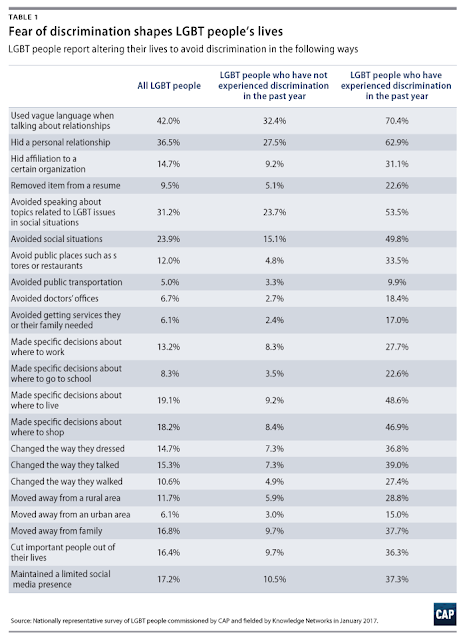
Click to make larger.

As Table 1 shows, LGBTI people who’ve experienced discrimination in the past year are significantly more likely to alter their lives for fear of discrimination, even deciding where to live and work because of it, suggesting that there are lasting consequences for victims of discrimination. Yet findings also support the contention that LGBTI people do not need to have experienced discrimination in order to act in ways that help them avoid it, which is in line with empirical evidence on a component of minority stress theory: expectations of rejection.

Not only can threatened discrimination bar LGBTI people from living authentically—it can also deny them material opportunities. Rafael J.,* a gay student in California, told CAP that he “decided to apply to law schools only in LGBTI-safe cities or states,” denying him the opportunity pursue his graduate education at schools he might otherwise have applied to. “I did not think I would be safe being an openly gay man,” he said. “Especially a gay man of color, in some places.”

Unique vulnerabilities in the workplace
Within the LGBTI community, people who were vulnerable to discrimination across multiple identities reported uniquely high rates of avoidance behaviors.

In particular, LGBTI people of color were more likely to hide their sexual orientation and gender identity from employers, with 12 percent removing items from their resumes—in comparison to 8 percent of white LGBTI respondents—in the past year.

Similarly, 18.7 percent of 18- to 24-year-old LGBTI respondents reported removing items from their resumes—in comparison to 7.9 percent of 35- to 44-year-olds.

Meanwhile, 15.5 percent of disabled LGBTI respondents reported removing items from their resume—in comparison to 7.3 percent of nondisabled LGBTI people. This finding may reflect higher rates of unemployment among people of color, disabled people, and young adults; it may also reflect that LGBTI people who could also face discrimination on the basis of their race, youth, and disability feel uniquely vulnerable to being denied a job due to discrimination, or a combination of factors.

Unique vulnerabilities in the public square
Discrimination, harassment, and violence against LGBTI people—especially transgender people—has always been common in places of public accommodation, such as hotels, restaurants, or government offices. The 2015 United States Transgender Survey found that, among transgender people who visited a place of public accommodation where staff knew or believed they were transgender, nearly one in three experienced discrimination or harassment—including being denied equal services or even being physically attacked.

In March 2016, then North Carolina Governor Pat McCrory signed H.B. 2 into law, which mandated anti-transgender discrimination in single-sex facilities—and began an unprecedented attack on transgender people’s access to public accommodations and ability to participate in public life.

That year, more than 30 bills specifically targeting transgender people’s access to public accommodations were introduced in state legislatures across the country. This survey asked transgender respondents whether they had avoided places of public accommodation from January 2016 through January 2017, during a nationwide attack on transgender people’s rights.

Among transgender survey respondents:
  • 25.7 percent reported avoiding public places such as stores and restaurants, versus 9.9 percent of cisgender LGBTI respondents 
  • 10.9 percent reported avoiding public transportation, versus 4.1 percent of cisgender LGBTI respondents 
  • 11.9 percent avoided getting services they or their family needed, versus 4.4 percent of cisgender LGBTI respondents 
  • 26.7 percent made specific decisions about where to shop, versus 6.6 percent of cisgender LGBTI respondents These findings suggest that ongoing discrimination in public accommodations pushes transgender people out of public life, making it harder for them to access key services, use public transportation, or simply go to stores or restaurants without fear of discrimination. 

Disabled LGBTI people were also significantly more likely to avoid public places than their nondisabled LGBTI counterparts. Among disabled LGBTI survey respondents, in the past year:

  • 20.4 percent reported avoiding public places such as stores and restaurants, versus 9.1 percent of nondisabled LGBTI respondents
  • 8.8 percent reported avoiding public transportation, versus 3.6 percent of nondisabled LGBTI respondents
  • 14.7 percent avoided getting services they or their family needed, versus 2.9 percent of nondisabled LGBTI respondents
  • 25.7 percent made specific decisions about where to shop, versus 15.4 percent of nondisabled LGBTI respondents


This is likely because, in addition to the risk of anti-LGBTI harassment and discrimination, LGBTI people with disabilities contend with inaccessible public spaces. For example, many transit agencies fail to comply with Americans with Disabilities Act, or ADA, requirements that would make public transportation accessible to people with visual and cognitive disabilities.

Unique vulnerabilities in health care 
In 2010, more than half of LGBTI people reported being discriminated against by a health care providers and more than 25 percent of transgender respondents reported being refused medical care outright. Since then, LGBTI people have gained protections from health care discrimination—most notably, regulations stemming from the Affordable Care Act, or ACA, have prohibited federally funded hospitals, providers, and insurers from discriminating against LGBTI patients. Despite progress, LGBTI people, and transgender people in particular, remain vulnerable to healthcare discrimination: In 2015, one-third of transgender people who saw a health care provider reported “at least one negative experience related to being transgender.” These negative experiences included being refused treatment or even being physically assaulted. Transgender people of color and people with disabilities reported particularly high rates of discrimination from health care providers.

Unsurprisingly, people in these vulnerable groups are especially likely to avoid doctor’s offices, postponing both preventative and needed medical care:
  • 23.5 percent of transgender respondents avoided doctors’ offices in the past year, versus 4.4 percent of cisgender LGBTI respondents 
  • 13.7 percent of disabled LGBTI respondents avoided doctors’ offices in the past year, versus 4.2 percent of nondisabled LGBTI respondents 
  • 10.3 percent of LGBTI people of color avoided doctors’ offices in the past year, versus 4.2 percent of white LGBTI respondents 

These findings are consistent with research that has also identified patterns of health care discrimination against people of color and disabled people. For example, one survey of health care practices in five major cities found that more than one in five practices were inaccessible to patients who used wheelchairs.

A call to action 
To ensure that civil rights laws explicitly protect LGBTI people, Congress and all States should pass an Equality Act, a comprehensive bill banning discrimination based on sexual orientation and gender identity in employment, public accommodations, housing, credit, and federal funding, among other provisions.

*Authors’ note:  All names have been changed out of respect for interviewees’ privacy.

Methodology 
To conduct this study, CAP commissioned and designed a survey, fielded by Knowledge Networks, which surveyed 1,864 individuals about their experiences with health insurance and health care. Among the respondents, 857 identified as lesbian, gay, bisexual, and/or transgender, while 1,007 identified as heterosexual and cisgender/nontransgender. Respondents came from all income ranges and are diverse across factors such as race, ethnicity, education, geography, disability status, and age. The survey was fielded online in English in January 2017 to coincide with the fourth open enrollment period through the health insurance marketplaces and the beginning of the first full year of federal rules that specifically protect LGBT people from discrimination in health insurance coverage and health care. The data are nationally representative and weighted according to U.S. population characteristics. All reported findings are statistically significant unless otherwise indicated. All comparisons presented are statistically significant at the p < .05 level.

Separate from the quantitative survey, the authors solicited stories exploring the impact of discrimination on LGBT people’s lives. Using social media platforms, the study authors requested volunteers to anonymously recount personal experiences of changing their behavior or making other adjustments to their daily lives to prevent experiencing discrimination. Interviews were conducted by one of the study authors and names were changed to protect the identity of the interviewee.

Additional information about study methods and materials are available from the authors.

Friday, October 13, 2017

Governor Bevin needs Education on Medical Marijuana

Governor Matt Bevin needs to be educated on medical marijuana. "The news article 'Marijuana Overdoses Kill 37 in Colorado On First Day of Legalization' was a hoax, but the Governor isn't well read enough to realize this. By the time the commonwealth legalizes medical marijuana, it will be too late for Kentuckians to benefit from it," stated Kentucky Equality Federation Secretary-General Jordan Palmer.

"'People will drive when they are stoned' some say, well, in Kentucky, it is illegal to #drive on high blood pressure medication, pain medication, etc. so they are already driving stoned. I am however pleased the Governor gave us a way to remedy the situation by stating 'as long as I am Governor' well, thankfully we will have an election soon enough."

"We are sick of big brother and government telling the unemployed what they can and cannot do to earn a living. Marijuana addiction is rare, the chances are greater to become an alcoholic. Marijuana cannot lead to a fatal overdose, and it is not a gateway drug. I hope the Kentucky House of Representatives and the Kentucky Senate will pass the legislation and should the Governor veto it, I pray they override his veto. The mentality of the Bevin Administration is to be last at everything, and unemployment isn't on their minds; thousands of unemployed coal miners could easier become marijuana farmers."

"Again we have an Administration in Frankfort, Kentucky that doesn't care about the Southern Region of the Commonwealth. I had much rather our youth use marijuana as a recreational drug than cocaine or crystal meth."

Thursday, March 17, 2016

Kentucky Equality Federation vows to sue if Senate Bill 180 becomes law

The Interim Membership Committee of the Kentucky Equality Federation voted to permit the president or secretary-general of the alliance to sue the Commonwealth of Kentucky if Senate Bill 180 is passed by the House of Representatives and signed into law by Governor Matt Bevin.

Senate Bill 180 would legally protect businesses that, refuse to service gay and lesbian couples because of the 'religious beliefs' of management/owner.

“This law is unconstitutional, just as it would have been more than fifty years ago when governments passed similar laws related to interracial couples, and 'white schools not permitting 'black students', the very notion of offensive. ” stated Secretary-General Jordan Palmer. “Having sued the Commonwealth for marriage equality in addition to forcing single religious views out of public schools, our legal department is more than ready.”

Palmer added: "This is absolutely ridiculous. What's next? Separate restrooms?"

The Kentucky Equality Federation alliance includes Marriage Equality Kentucky, Southeastern Kentucky Stop Hate Group, Western KY Community Education Project, Kentucky HIV Advocacy Campaign, and Kentucky Equal Ballot Access. The Federation funds alliance members and each receive a single vote for a unifying secretary-general.

Thursday, September 12, 2013

Kentucky Equality Federation sues the Commonwealth of Kentucky for marriage equality

On Tuesday, September 10, a lawsuit was filed on behalf of the Kentucky Equality Federation against the Commonwealth of Kentucky.

This lawsuit is the latest attempt to achieve equal rights and protections for families across the Commonwealth whose very existence has been banned by the forces of religious zealotry and hatred.

NOTE: A complete digital copy of Kentucky Equality Federation v. Commonwealth of Kentucky is available here in PDF format, the Case # 13-CI-1074. The lawsuit was conceived by President Jordan Palmer, written and signed by Vice President of Legal Jillian Hall, Esq., and Mark A. Morenz-Harbinger, Esq.

At the heart of the suit is the premise that the 2004 amendment to the Kentucky Constitution was passed in violation of the Constitution.

Jill Hall, Esq.,
Vice President of Legal
"In 2004, social conservatives, who normally try to hide behind the Constitution, decided that it wasn't good enough for them anymore," said Kentucky Equality Federation President Jordan Palmer.

They decided to rewrite a document which guarantees freedom and to pervert it to fit their own jaded hatred of gay and lesbian couples. This was done despite the fact that it negated part of the bill of rights. We, as Kentuckians, must undo this immoral amendment which subverts the soul of our Commonwealth, our rights, and the government of Kentucky.

Lawmakers in Frankfort put something to the people for a vote that was unconstitutional if you read Kentucky’s constitution. The Kentucky constitution is the supreme governing document of the commonwealth; its provisions provide GREATER freedoms than the U.S. constitution.

Kentucky added a facially unconstitutional amendment to its constitution via a ballot initiative process. Thus, the attempt to abrogate constitutional sensibilities in favor of a ballot initiative, as was done for Section 233A of the Kentucky Constitution in 2004, is against the very notion of equal protection as guaranteed to each and all of Kentucky’s population. This should be held as true as a matter of law by the Courts, regardless of the ballot’s outcome."

"Fear of the LGBTI community reached a high-water mark after DOMA," said Kentucky Equality Federation Vice President of Policy & Public Relations Joshua Koch.

"Roving bands of lobbyists funded by extremist elements traveled the country for years vandalizing generations-old institutions and spreading lies and fear in several states. In 2004, they struck Kentucky, traditionally a leader in the region on civil rights, and managed to apply their graffiti to the Constitution, which had been in effect for 113 years. We are simply trying to undo the damage done."

Wednesday, March 27, 2013

Kentucky House overrides Governor's veto of House Bill 279

House Bill 279 Statement

BY:  Jordan Palmer

Kentucky Equality Federation is extremely disappointed with House leadership for overriding House Bill 279, the "Forced Religion Imposition Act."  Allowing the House Democratic Caucus to vote 'anonymously' to decide to override the veto isn't open government and it isn't transparency, it is however cowardly. 

People and organizations around the commonwealth from mayors to citizen activists organized to oppose this dreadful and hurtful legislation. Kentucky Equality Federation has pushed to have this bill vetoed before it passed the Senate Judiciary Committee, but with overwhelming support from Republicans and Democrats, this is legislation we couldn't kill with a simple telephone call or meeting.

House Bill 279 does nothing more than give people permission to discriminate based on their religious beliefs thereby taking it beyond ‘freedom of religion’ to ‘forced religion’ because they can impose their religious beliefs on others with legal authority to do so.

Kentucky lawmakers needed to define language in House Bill 279 before it became law such as what constitutes a ‘burden’ and what constitutes a ‘substantial’ burden to someone’s religious beliefs.

As noted by our Vice President of Legal, Jillian Hall, Esq., similar laws to this proposed bill have been passed in several other states after the U.S. Supreme Court struck down the U.S. Religious Freedom Restoration Act in 1997 (as applied to the states), though it remains federal law.

Until last night however, this law did not apply to the commonwealth of Kentucky.
As I have said before, the Kentucky Democratic Party is out of touch with the national Democratic Party. However, this was expected, given the continued loses Democrats have suffered since the 2010 election to Tea Party Republicans, Democrats cannot appear to be soft on Religion. Even with loses, this does not justify sacrificing your political beliefs.

Still, it remains to be seem if House Bill 279 can withstand a court challenge which our legal department is working on now. 

In the future, because of threats related to House Bill 279, not only will our toll-free number override anonymous callers, but being calling the Office of Chairman of the Board (the Chair and Vice Chair) or members of the Office of the President (the President and all Vice Presidents) will be recorded.  One lady also called to ask if it was legal to say LGBTI people are abominations at the rally the Family Foundation of Kentucky held on Tuesday.

House Bill 279 has the potential to harm local ordinances in place in Covington, Louisville, Lexington and Vicco.  Kentucky Equality Federation's legal department will sue the commonwealth of Kentucky with the first complaint we receive that House Bill 279 has been used to justify discrimination, termination, or school bullying regardless of sexual orientation or gender identity. 

People also made threats about the Red State Brief which Kentucky Equality Federation signed with 25 other statewide organizations with the U.S. Supreme Court. The brief contends that many local state laws are designed to routinely deny gay citizens basic civil rights, and many state codes are woven in a tangle that can only be unraveled by the courts.

Kentucky Equality Federation again thanks every person and every organization who made a stand with us on the right side of history.

Friday, March 22, 2013

Governor Beshear Vetoes House Bill 279

STATEMENT ON HOUSE BILL 279

Jordan Palmer, President

The Kentucky Equality Federation is ecstatic to hear and report of Governor Beshear's veto of House Bill 279, the 'Forced Religion Imposition Act.'

I have spoken in detail to officials in the Governor's Office as well as senior Representative Ruth Ann Palumbo, also the chair of the House Standing Committee on Economic Development about House Bill 279. Senior Representative Palumbo changed her vote once she realized the far reaching implications House Bill 279 has.

People and organizations around the commonwealth from mayors to citizen activists organized to oppose this dreadful and hurtful legislation. Kentucky Equality Federation has pushed to have this bill vetoed before it passed the Senate Judiciary Committee, but with overwhelming support from Republicans and Democrats, this is legislation we couldn't kill with a simple telephone call or meeting.

Governor Beshear is pushing Kentucky to once again being a leader in civil rights protection for minorities throughout the Commonwealth by not infringing on their city equality ordinances in Covington, Lexington, Louisville, and Vicco.

We applaud Steve Beshear for being an effective Governor and Commander-in-Chief; to quote Martin Luther King, Jr., ‘A genuine leader is not a searcher for consensus but a molder of consensus,’ and Governor Beshear has done exactly that.

Both Republicans and Democrats need to think carefully before deciding to override a veto since the governor and his legal staff has listened to both sides of the argument.

House Bill 279 did nothing more than give people permission to discriminate based on their religious beliefs thereby taking it beyond ‘freedom of religion’ to ‘forced religion’ because they have imposed their religious beliefs on others with legal authority to do so.

Kentucky lawmakers needs to first define language in House Bill 279 before it becomes law. What constitutes a ‘burden’ is undefined in the proposed law. One of the amendments proposed and accepted by Representative Owens also fails to qualify what a ‘substantial’ burden to someone’s religious beliefs are.

Wednesday, March 6, 2013

Kentucky Equality Federation letter to Governor Beshear to veto House Bill 279

Kentucky Equality Federation urges Governor Steve Beshear to veto House Bill 279, the "FORCED RELIGION IMPOSITION ACT."

Click here to view a copy in PDF.

The Honorable Steve Beshear
Governor and Commander-in-Chief of the Commonwealth of Kentucky
Capitol Office 700 Capitol Avenue
Suite 100
Frankfort, Kentucky 40601

The Honorable Steve Beshear
Governor and Commander-in-Chief of the Commonwealth of Kentucky
The Governor's Mansion
704 Capitol Avenue
Frankfort, KY 40601

Kentucky Equality Federation, a non-government (NGO), non-profit organization with United Nations NGO observer and consultative status for minority issues hereby urges you to veto House Bill 279 for reasons outlined below. Kentucky Equality Federation has no doubt this legislation will pass the Senate having passed the House of Representatives.

Kentucky Equality Federation is Kentucky's largest all-volunteer grassroots lesbian, gay, bisexual, transgender, and intersex ("LGBTI") civil rights and advocacy organization for both social and political equality. 
Kentucky Equality Federation believes all people are endowed with inalienable rights to life, liberty, property, and the pursuit of happiness and fulfillment free from oppression, discrimination, school bullying, and hate crimes regardless of gender identity, sexual orientation, race, creed, veteran status, political affiliation, or any other defining characteristic. 
The end of discrimination is not simply the elimination of flagrant abuses, rather it is the ability of a person to fully exercise their Kentucky human rights to the same full extent enjoyed by their peers, without fear of retribution, aspersion, or harm, be that harm political or social.
We assist and act as public advocate for people who have been bullied, discriminated against, or victimized in addition to assisting them with legal remedies. 
When the laws have not caught up to the moral needs of society, we will seek their modification, pursuant to the creation of a just society. 

Kentucky Equality Federation also asks if House Bill 279 would violate your executive order 2008-0473, prohibiting discrimination based on sexual orientation or gender identity in Kentucky’s Government.

FOLLOWING ARE COMMENTS BY PRESIDENT JORDAN PALMER:  
The emancipation of slaves, voting rights for women, and the civil rights movements were landmark victories for the cause of equality, but this struggle continues today and House Bill 279 is nothing short of legal discrimination against a minority group otherwise unprotected by the laws of this commonwealth.

House Bill 279 represents a clear and present danger to the gay and lesbian community and other minority groups around the commonwealth. Both the Kentucky and U.S. constitution provide for freedom of religion and Kentucky Equality Federation supports freedom of religion.

As you know, in 2010 the Kentucky House of Representatives passed Resolution 232, the Manhattan Declaration making Christianity the official religion of the Commonwealth.

House Bill 279 does nothing more than give people permission to discriminate based on their religious beliefs thereby taking it beyond ‘freedom of religion’ to ‘forced religion’ because they have imposed their religious beliefs on others with legal authority to do so.

FOLLOWING ARE COMMENTS BY VICE PRESIDENT OF LEGAL JILLIAN HALL, Esq.:
House Bill 279 has the potential to harm local ordinances in place in Covington, Louisville, Lexington and Vicco.

Essentially, an individual can continue to discriminate against a gay individual in violation of the ordinance and be protected under this new law by showing that it is in conflict with their closely held religious beliefs. While the language adding “substantial” to the burden (via an amendment to the bill) does add some protections, the law still is a major step backward for the equality movement.

Right now, people discriminate freely and openly against the gay community without recourse due to the lack of a Kentucky statewide equality law.

Similar laws to this proposed bill have been passed in several other states after the U.S. Supreme Court struck down the U.S. Religious Freedom Restoration Act in 1997 (as applied to the states).

This law is nothing more than a poor recitation of the First Amendment, and is a thinly veiled move by the legislature showing their lack of respect or tolerance for the lesbian, gay, bisexual, transgendered, and intersex community (LGBTI).

While I do not feel that this will significantly affect anything in the courts, this law, along with the Manhattan Declaration of 2010 acts to block forward progress and is a continued embarrassment for the Commonwealth.

FINAL COMMENTS BY PRESIDENT JORDAN PALMER:
Governor, today the U.S. President signed domestic violence protections which included the LGBTI community. Though we support the sovereignty of the commonwealth of Kentucky against an oversized and intrusive federal government, we have no choice but to continue to turn to them for protections because our Kentucky lawmakers continue to fail us.

We again appeal to you to as our chief of state and chief of government to veto House Bill 279.

Please feel free to contact us with any questions you may have regarding this matter toll-free at (877) KEF-5775 – Ext. 5.